
What makes you feel good, happy, and secure? Depression is the top mental health issue around the world. It can be treated with medication, but it can also be treated by increasing the hormone and neurotransmitter dopamine in the brain. Dopamine gives you pleasure and regulates your mood. It helps us focus, work towards goals, and find things interesting. Warning: dopamine is the root precipitator for all addictions.
Achieving Goals
How do you feel after you accomplish a goal? When you achieve a goal, does it make you feel rewarded and good? That is because accomplishments increase the feel-good hormone dopamine in your brain. At one time, I was addicted to the dopamine hit from reaching goals, and I became a workaholic. I would make lists of goals I wanted to accomplish, and with each achievement, I would feel a sense of satisfaction. I used achieving goals to cover my mental health problems, to forget about my past. Once I healed my past issues through prayer and memory healing, I was no longer addicted to achieving goals, though I still like the reward I feel when I do achieve a goal.
Exercising
As we enter a new year, most of us have a goal of exercising more and losing weight. Exercising every day is the best way to increase dopamine in your brain. Exercise not only increases your quality of life but also reduces dementia risk, increases energy, and improves your mood and sleep. There are many articles written about the benefits of exercise, so I encourage you to read them, write down the benefits, and review them every day to remind you why you need to exercise. I don’t know about you, but the older I get, the less I feel like exercising, even though I know it is more important now than ever before.
Do you know people who are addicted to exercise? They exercise for hours a day. This is because they seek the dopamine highs. I never had this problem. Some people are addicted to food because it gives them the same dopamine hit. I will blame my grandparents for feeding me candy and cookies when I went to their house. I became addicted to sugar-laden treats for the feel-good dopamine high it gave me. If you think you are addicted to increasing the dopamine hormone response, then please seek professional counseling. Recently, Jelly Roll was in the news talking about his 300 lb weight loss. Yikes, what an accomplishment. In the article, he admitted to having a food addiction that he got therapy for. Most addictions cover up the effects of painful memories. So, healing painful memories is important to overcome addiction. See my onlinebook to learn how I overcame my addictions.
Helping Others
The third way to increase dopamine is to help other people, especially if they can’t return any benefit to you. Here is an excellent article called “The Surprise Science Behind Why Helping Others Helps You.” I love to help others, now I know why.
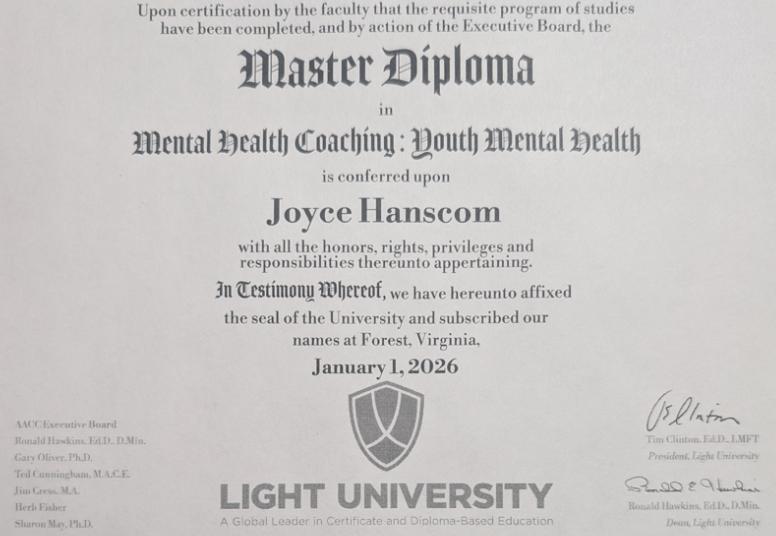
I had a long list of goals when I retired, and one of them was to finish a 43-hour Child and Youth Mental Health Coaching program from Light University. I finished the program on December 31, 2025, after two years. I learned how to coach parents to understand their children and help them build emotional resilience. I wanted to equip myself with the knowledge I needed to be the most help to hurting people. Do you find you don’t want to be around messy, dysfunctional people? But they are the ones who need the most help. I love to read how my website has helped people and given them hope. This makes me feel good.
With each class I took on Youth Mental Health Coaching, I learned how dysfunctional my family was and how messed up I was as a child and a parent. I also realized that by the grace of God and His healing power, I am now emotionally resilient and secure. There is hope, which is why I developed the Hope for Complete Healing website and wrote the book with the same name.
Mental Health Coaching Programs
If you are interested in enrolling, go to LightUniversity.com and select Mental Health Coaching. I wrote about the first Mental Health Coaching program I completed in this post. Here are some of the great topics you will learn about in the Youth Mental Health Coaching program.
Childhood Trauma and Adverse Childhood Experiences – Shannae Anderson, Ph.D.
Managing Stress and Anxiety in Children and Teens – Gregory L. Jantz, Ph.D.
Moody: Understanding Depression and Mood Disorders – Gregory L. Jantz, Ph.D.
Battling Loneliness and Bullying – Mark Mayfield, Ph.D.
Buzzed: Winning the Alcohol and Substance Abuse War – John Eklund, M.S.W.
A New Normal: Helping Kids and Teens through Grief and Loss – Jennifer Ellers, M.A.
Anger, Defiance, Rebellion, and Violence: When Kids Go Awry – Gary Sibcy, Ph.D.
Pornography, Sex, Sexting and Sexuality – Jim Cress, M.A.
Walking a Thin Line: Health, Diets, and Eating Disorders – Amy Feigel, M.A.
Guidance and Support for Children with Developmental Disabilities – Stephanie Holmes, Ed.D.
Attention Deficit Hyperactivity Disorder (ADHD), Autism Spectrum Disorders (ASD), and Oppositional Defiant Disorder (ODD): Behavior Patterns, Issues and Intervention – E. John Kuhnley, M.D.
Everything is Changing: Brain Health, Hormones and the Neurobiology of Youth and Development – Gary Sibcy, Ph.D.
The Use of Psychiatric Medication in the Mental Health Treatment of Children and Adolescents – E. John Kuhnley, M.D.
Love and Limits: Parenting, Boundaries and Structure – Mercy Connors, Ph.D.
Emotion Coaching and Regulation for Children and Adolescents – Gary Sibcy, Ph.D.
Connecting with Kids through the World of Play – Daniel Sweeney, Ph.D.
Decisions and Consequences: Making Wise Choices When It Counts – Karl Benzio, M.D.
Conflict Management and Resolution – Karl Benzio, M.D.
Cultural Identity – Mark Crear, Ph.D.
Performance, Pressure, and Identity: Managing Sports, Academics, and Life – Zach Clinton, M.A.
The Wired Generation: Technology, The Brain, Social Media and Behavior – Mark Mayfield, Ph.D.
Helping Parents Teach Their Youth About Healthy Sexuality – Jim Burns, Ph.D.
Gender Identity and Ideologies: Helping Parents and Families When Youth Come Out as LGBTQ – Kathy Koch, Ph.D.
Family Systems: Understanding Generational Patterns – John Eklund, M.S.W.
Childhood and Adolescent Development: An Attachment Perspective – Anita Kuhnley, Ph.D.
Prodigal Children: Helping Parents Stand Strong and Trust God in the Midst of Heartache and Brokenness – Mark Mayfield, Ph.D.
Divorce and Living in Blended Families – Jay Daughtry, M.A., and Tammy Daughtry, M.A.
Family Strong: Helping Families Survive and Thrive in the Storms of Life – Shannae Anderson, Ph.D., and Mercy Connors, Ph.D.
There is hope for complete healing. Reach out to me at hopeforcompletehealing@gmail.com if you have questions or need free mental health coaching.

 Hope for Complete Healing