Who or What Controls You?

Are you emotionally affected by what people say or do? How do you feel when someone is unkind to you or is upset with you? Some people couldn’t care less about what others say or do, yet others like me are very sensitive to the slightest criticism or rejection. A co-worker told me that I don’t have to give people power over me. I think of that statement often. So today, I am going to write about how to overcome controlling thoughts. 

Last week I wrote about “How to Increase Emotional Intelligence.” If you haven’t read that post yet, please do so. In this post, I want to expand on the concepts in last week’s post. Without a healthy spiritual life, you will be tossed about by every wind of doctrine or someone’s feelings or convictions that may not be based on truth (Eph. 4:14). 

Controlled by Our Thoughts. 

We all want to be accepted, respected, and loved, so when someone is rude or critical toward us, we feel offended. The offense may not be intentional, but we interpret their words or actions as offensive. So, we are really being controlled by our thoughts and how we interpret the other person’s words or actions. For example, I was working on transforming a cargo van into a camper van. My mother-in-law criticized my work. I became offended and upset. What should I have done instead? 

  • I should have taken captive her critical words and said, “That is your opinion (or something like that). Remember, we all want approval, so I took her comment as disapproval, which made me mad. Then she got offended when I became offended. 
  • I have a choice: either let other people’s words or actions into my mind or put them out as I do the trash. 
  • I could have thanked her for her observation and let her words drop to the ground. I have the choice to take offense or let it go, unless a personal boundary is crossed. 
  • We become offended and controlled by our thoughts when we are disappointed. So, recognize that you are disappointed by an unmet expectation, voice your disappointment, but do not give in to the temptation to say something mean or demeaning. Do your best not to phrase your disappointment as a criticism, but say, “I felt… when you said (or did)….” 
  • Not returning a mean or sarcastic comment when you feel offended is hard; that is where emotional intelligence and Spiritual maturity come in. I must admit, I am not as quick as I need to be at taking offensive thoughts captive. But I am getting quicker at recognizing and correcting them and not letting them control my feelings or ruin my relationships with people. 

How To Stop Being Controlled by Other People’s Feelings. 

Because we instinctively want approval, most people want to please others to win their approval. How do you feel when someone is unkind to you or is upset with you? I feel hurt or rejected. How about you? How do you feel? Again, we are allowing others’ feelings to create thoughts of insecurity, anger, or sadness. So, what should we do when someone’s feelings control our thoughts and emotions? 

  • Recognize what you are feeling and the thoughts you have about the situation that is controlling your feelings. For example, my husband was trying to be helpful, but he felt I was not appreciative enough (his expectation was not met), so he was mad. This controlled how I felt, and my pride showed up to back up that I was appreciative, and I didn’t need to kiss his butt. 
  • I took my hurt feelings captive and humbled myself to talk to him about not meeting his expectations and how my expectations were not met, which hurt my feelings. He then justified his hurt feelings and said mean things, so I left. I humbled myself again and said that we should not go to bed angry, so I put off my hurt feelings and focused on what I could be thankful for. 
  • Remember, Satan does not want us to live in peace. He is always sowing strife to create chaos and division. Recognizing this will help you put off your pride, humble yourself to apologize for not meeting the other person’s expectations, and ask for their forgiveness. 
  • Forgiveness is the key to peace and joy. If the other person still wants to be hurt and angry, then you may need to set boundaries, but let them work through their hurt. Sometimes they will stay offended no matter what you do. Recognize that you cannot control how someone feels or what they do; you can only control how you feel and what you do. 

Conclusion 

People will have a bad day or feel like being mean; you don’t have to let their feelings or words control you. Be mindful to give grace because you may need grace from others when you are having a bad, frustrating day. For example, I have a neighbor who is ornery and yells at everyone. He came over, yelled at me, and threatened to call the EPA because I was putting leaves in the stream that flowed by my house. I live in the woods, and tree leaves blow into the stream all the time. I did not allow his unkind words or threats to affect my mood or thoughts. To learn how to do this, read my last post on how to increase your emotional intelligence. 

RELATED POSTS 

Posts on Thoughts 

Healthy Boundaries for Toxic Emotions and People 

How to Respond to Criticism 

The Link Between Disappointment, Resentment, and Self-control 

How to Develop Emotional Resilience 

********************* 

All verses are from the English Standard Version. If you find my posts and website helpful, please share this link with your friends and family: hopeforcompletehealing.com. The information is copyright protected. Please do not reproduce any part of the posts or my book without proper citation to Joyce Hanscom and this website.  

My latest book, Unlocking God’s Promises, explains 18 categories of relevant promises to each of our lives. It also includes the promises in Psalm 91.   

If you find this website helpful, you would like to read Breaking Mental Strongholds, which expands on my website book and includes many of my posts.  

Additionally, consider my book Fighting Unseen Battles, which describes the many unhealthy beliefs that control our lives and what the truths are. To learn more about this book, read the post How to Fight Unseen Battles

Contact me at hopeforcompletehealing@gmail.com, and ask for a PDF of Eight Life-changing Prayers from the Bible. The prayers are for the Spirit of wisdom, renewal, spiritual strength, knowledge of His will, virtues of God, non-believers, 23rd Psalm, and victory. I will also send you the Lord’s Prayer Model to pray effectively. Please leave your name, so I know you are a real person making the request. 

How to Increase Emotional Intelligence 

So, what does emotional intelligence and complete healing look like? I discovered that complete healing encompasses three key areas of your life: mental, physical, and spiritual. These three areas affect your level of emotional intelligence. (I had to take a break from blogging because I broke my hand and couldn’t type.) 

Emotional intelligence is your ability to make a thoughtful, healthy choice about how you respond to a stressful situation rather than reacting. I am a reactor because that is how I was conditioned in my formative, dysfunctional home life. I am learning to respond by taking my reactive thoughts captive, setting them aside, and choosing to respond according to the fruit of the Spirit (Gal. 22-23). Are you a reactor or a responder? Do you respond with thankfulness or complaining? Do you respond with grace or anger? Do you respond with love or hate, malice, or scoffing? Do you respond with humility or pridefulness? 

My blog focuses on achieving complete healing in the three key areas of your life so you can respond with love and a sound mind to stressful situations. Stress can range from stubbing your toe to facing a cancer diagnosis. I determined that spiritual health is the key to physical and mental health. Spirituality is the third dimension of each human being. In the last 13 posts, I explained how to recognize your spiritual adversary (i.e., the devil and demons). The unseen spirit world attacks you spiritually, physically, and mentally, so being spiritually healthy mitigates these attacks. Your spiritual health also determines how you respond to stressful situations. 

A Healthy Spiritual Life

1. A healed spiritual life begins with believing in Jesus Christ as your Savior, who saves you from the wrath of God for sin and the devil’s control. (Rom. 10:9-10Rom. 5:9-11Col. 2:8-10). 

2. Repent of your sins (Luke 13:3&5; Acts 3:1926:20Rom. 6). 

3. Accept the help of the Holy Spirit to forgive and love others well, which is proof of a healthy soul (Eph. 3:16-19Col. 3:12-16; and 1Pet. 1:22). 

4. Trust God as your healer, provider, and protector (Ex. 15:26Ps. 68:5Phil. 4:19). 

5. Put off your old way of thinking, which leads to sinful behavior (Eph. 4:22-27). 

6. Focus on God’s truth, love, joy, peace, forgiveness, faithfulness, humility, and so on; then those traits will also become yours (1Tim. 6:11 and 2Tim. 2:22). 

7. Show mercy and grace by forgiving those who hurt and offend you (Matt. 6:14-15). 

8. You cannot be spiritually, mentally, or physically healthy if you are bitter, prideful, and unthankful (Heb. 12:151John 2:16; and 2Tim. 3:1-5). 

9. Read your Bible, go to church, pray, and work through the painful issues of your life so you can love from a pure heart (Josh. 1:8Ps. 1Heb. 10:24-252Cor. 7:11Pet. 1:22). 

10. Spiritual health is evident in humility, complete surrender to God, drawing near to Him, and repenting of sin (James 4:6-8). Submission to Him means obeying Him and resisting the devil, who wants to keep you in bondage to bitterness, pridefulness, and complaining. 

A spiritually healthy prayer life supports sound mental health. Especially when you submit your painful memories to God for healing and forgive those who sinned against you. Without God, your memories won’t be healed. Painful memories negatively affect your mental and physical health, which lowers your emotional intelligence because you react from your pain. You can learn to manage your emotions from the pain of your past, but they will still cause you to react negatively instead of responding positively to stressful or painful situations. Also, Satan cannot read your mind, but he knows what you say and will use the negative experiences you complain about to keep you in bondage to offense, which lowers your emotional intelligence. 

For example, I have a family member who has a lot of mental and physical health problems. She hasn’t purified her heart from the trauma of her past, and she is still bitter and prideful. Her trauma memories prevent her from being spiritually healthy, which is evident in the quality of the fruit of the Spirit in her life and reactions (Gal. 5:22-25). 

How Does a Healthy Person Respond? 

A completely healthy person values themselves and others, and their emotional intelligence will reflect that. They’re going to care for themselves physically by eating well and exercising. Next, they receive God’s forgiveness and love, so they can love themselves, love and forgive others well. If you don’t love yourself and take care of yourself, you can’t love others. But if you have a lot of traumas in your past where people did not love you well, it will affect how you respond. So, you need to deal with the trauma of your past through God’s healing power and love. For you to respond with love, you must receive His forgiveness of your sins and His mercy and grace; then you can give His love, His mercy, and His grace to others. Who has offended you or hurt you? Understand that they may be acting out of their own trauma and pain in their life. Or they may be reacting from their sinful flesh. Spiritually healthy people forgive and show mercy. 

In 2025, I discussed various mental health issues and ways to improve them. You will find those posts on my mental health page. I later discovered that physical health and mental health are related to your gut health (see Dr. Mark Hyman podcast). My physical and mental health improved greatly when I gave up sugar, corn, most wheat products, and began eating God’s way in Genesis 1:29, “And God said, “Behold, I have given you every plant yielding seed that is on the face of all the earth, and every tree with seed in its fruit. You shall have them for food.” These are recognizable foods in their whole form and not highly processed. Exercising regularly and fasting are also good for improving both physical and mental health. You can learn more in my post, Healing Depression: The Role of Gut Health and Diet. 

Conclusion 

The devil is constantly waiting to distract you and to cause you to be offended at God or others. Satan wants you to give up your faith and walk away from him or be offended at the church and people who go to church. And that’s why I just wrote a series on how the devil and demons interact with humans. You can read all these posts on my Spiritual Warfare Posts page.  Spiritually healthy people understand the spirit world and how it affects their mental and physical health. Emotional intelligence depends on strong spiritual health.  Praying through a stressful situation helps you respond with the fruit of the Spirit (Gal 5:22-23) instead of reacting from your sinful flesh or painful memories. Are you spiritually healthy?

Does this make sense? If not, please comment below on what does not make sense, so I can clarify it. 

RELATED POSTS 

Are you Spiritually Healthy? 

********************* 

All verses are from the English Standard Version. If you find my posts and website helpful, please share this link with your friends and family: hopeforcompletehealing.com. The information is copyright-protected. Please do not reproduce any part of the posts or my book without proper citation to Joyce Hanscom and this website.  

My latest book, Unlocking God’s Promises, explains 18 categories of relevant promises to each of our lives. It also includes the promises in Psalm 91.   

If you find this website helpful, you would like to read Breaking Mental Strongholds, which expands on my website book and includes many of my posts.  

Additionally, consider my book Fighting Unseen Battles, which describes the many unhealthy beliefs that control our lives and what the truths are. To learn more about this book, read the post How to Fight Unseen Battles.  my post called Breaking Mental Strongholds Book. Also, check out Fighting Unseen Battles on Amazon. To learn more about this book, read: How to Fight Unseen Battles

Contact me at hopeforcompletehealing@gmail.com, and ask for a PDF of Eight Life-changing Prayers from the Bible. The prayers are for the Spirit of wisdom, renewal, spiritual strength, knowledge of His will, virtues of God, non-believers, 23rd Psalm, and victory. I will also send you the Lord’s Prayer Model to pray effectively. Please leave your name, so I know you are a real person making the request. 

Three Great Ways to Increase Dopamine and Feel Good

What makes you feel good, happy, and secure? Depression is the top mental health issue around the world. It can be treated with medication, but it can also be treated by increasing the hormone and neurotransmitter dopamine in the brain. Dopamine gives you pleasure and regulates your mood. It helps us focus, work towards goals, and find things interesting. Warning: dopamine is the root precipitator for all addictions.

Achieving Goals

How do you feel after you accomplish a goal? When you achieve a goal, does it make you feel rewarded and good? That is because accomplishments increase the feel-good hormone dopamine in your brain. At one time, I was addicted to the dopamine hit from reaching goals, and I became a workaholic. I would make lists of goals I wanted to accomplish, and with each achievement, I would feel a sense of satisfaction. I used achieving goals to cover my mental health problems, to forget about my past. Once I healed my past issues through prayer and memory healing, I was no longer addicted to achieving goals, though I still like the reward I feel when I do achieve a goal.

Exercising

As we enter a new year, most of us have a goal of exercising more and losing weight. Exercising every day is the best way to increase dopamine in your brain. Exercise not only increases your quality of life but also reduces dementia risk, increases energy, and improves your mood and sleep. There are many articles written about the benefits of exercise, so I encourage you to read them, write down the benefits, and review them every day to remind you why you need to exercise. I don’t know about you, but the older I get, the less I feel like exercising, even though I know it is more important now than ever before.

Do you know people who are addicted to exercise? They exercise for hours a day. This is because they seek the dopamine highs. I never had this problem. Some people are addicted to food because it gives them the same dopamine hit. I will blame my grandparents for feeding me candy and cookies when I went to their house. I became addicted to sugar-laden treats for the feel-good dopamine high it gave me. If you think you are addicted to increasing the dopamine hormone response, then please seek professional counseling. Recently, Jelly Roll was in the news talking about his 300 lb weight loss. Yikes, what an accomplishment. In the article, he admitted to having a food addiction that he got therapy for. Most addictions cover up the effects of painful memories. So, healing painful memories is important to overcome addiction. See my onlinebook to learn how I overcame my addictions.

Helping Others

The third way to increase dopamine is to help other people, especially if they can’t return any benefit to you. Here is an excellent article called “The Surprise Science Behind Why Helping Others Helps You.” I love to help others, now I know why.

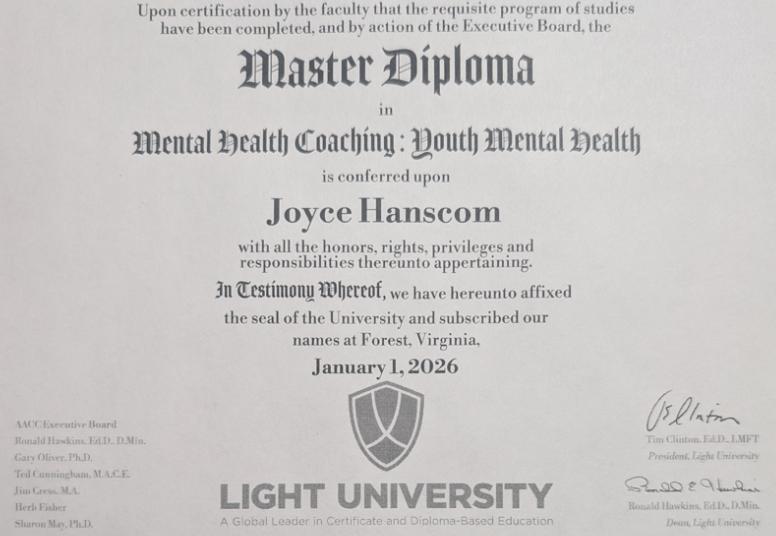
I had a long list of goals when I retired, and one of them was to finish a 43-hour Child and Youth Mental Health Coaching program from Light University. I finished the program on December 31, 2025, after two years. I learned how to coach parents to understand their children and help them build emotional resilience. I wanted to equip myself with the knowledge I needed to be the most help to hurting people. Do you find you don’t want to be around messy, dysfunctional people? But they are the ones who need the most help. I love to read how my website has helped people and given them hope. This makes me feel good. 

With each class I took on Youth Mental Health Coaching, I learned how dysfunctional my family was and how messed up I was as a child and a parent. I also realized that by the grace of God and His healing power, I am now emotionally resilient and secure. There is hope, which is why I developed the Hope for Complete Healing website and wrote the book with the same name. 

Mental Health Coaching Programs

If you are interested in enrolling, go to LightUniversity.com and select Mental Health Coaching. I wrote about the first Mental Health Coaching program I completed in this post. Here are some of the great topics you will learn about in the Youth Mental Health Coaching program.

Childhood Trauma and Adverse Childhood Experiences – Shannae Anderson, Ph.D.

Managing Stress and Anxiety in Children and Teens – Gregory L. Jantz, Ph.D.

Moody: Understanding Depression and Mood Disorders – Gregory L. Jantz, Ph.D.

Battling Loneliness and Bullying – Mark Mayfield, Ph.D.

Buzzed: Winning the Alcohol and Substance Abuse War – John Eklund, M.S.W.

A New Normal: Helping Kids and Teens through Grief and Loss – Jennifer Ellers, M.A.

Anger, Defiance, Rebellion, and Violence: When Kids Go Awry – Gary Sibcy, Ph.D.

Pornography, Sex, Sexting and Sexuality – Jim Cress, M.A.

Walking a Thin Line: Health, Diets, and Eating Disorders – Amy Feigel, M.A.

Guidance and Support for Children with Developmental Disabilities – Stephanie Holmes, Ed.D.

Attention Deficit Hyperactivity Disorder (ADHD), Autism Spectrum Disorders (ASD), and Oppositional Defiant Disorder (ODD): Behavior Patterns, Issues and Intervention – E. John Kuhnley, M.D.

Everything is Changing: Brain Health, Hormones and the Neurobiology of Youth and Development – Gary Sibcy, Ph.D.

The Use of Psychiatric Medication in the Mental Health Treatment of Children and Adolescents – E. John Kuhnley, M.D.

Love and Limits: Parenting, Boundaries and Structure – Mercy Connors, Ph.D.

Emotion Coaching and Regulation for Children and Adolescents – Gary Sibcy, Ph.D.

Connecting with Kids through the World of Play – Daniel Sweeney, Ph.D.

Decisions and Consequences: Making Wise Choices When It Counts – Karl Benzio, M.D.

Conflict Management and Resolution – Karl Benzio, M.D.

Cultural Identity – Mark Crear, Ph.D.

Performance, Pressure, and Identity: Managing Sports, Academics, and Life – Zach Clinton, M.A.

The Wired Generation: Technology, The Brain, Social Media and Behavior – Mark Mayfield, Ph.D.

Helping Parents Teach Their Youth About Healthy Sexuality – Jim Burns, Ph.D.

Gender Identity and Ideologies: Helping Parents and Families When Youth Come Out as LGBTQ – Kathy Koch, Ph.D.

Family Systems: Understanding Generational Patterns – John Eklund, M.S.W.

Childhood and Adolescent Development: An Attachment Perspective – Anita Kuhnley, Ph.D.

Prodigal Children: Helping Parents Stand Strong and Trust God in the Midst of Heartache and Brokenness – Mark Mayfield, Ph.D.

Divorce and Living in Blended Families – Jay Daughtry, M.A., and Tammy Daughtry, M.A.

Family Strong: Helping Families Survive and Thrive in the Storms of Life – Shannae Anderson, Ph.D., and Mercy Connors, Ph.D.

There is hope for complete healing. Reach out to me at hopeforcompletehealing@gmail.com if you have questions or need free mental health coaching.

14 Mental Health Indicators

If you had to rate your mental health from one to ten, what would it be? I learned to manage disappointment more effectively, to accept what I cannot control and to trust God, and to gently correct others’ offenses. My marriage improved because I stopped speaking negative words over it and replaced negative thinking with gratitude. I have spent the last year exploring ways to improve my mental and spiritual health. I was amazed by how much it affects our psychological and physical health. There is so much more to learn. The key takeaway from my research is that mental health and spiritual health are interrelated and directly affect your physical health. Therefore, the more spiritually healthy you are, the more mentally healthy you will be, and the more mentally healthy you are, the more physically healthy you will be. Read “Why Be Physically Healthy?

Mental Health Rating.

I created the following summary in the post titled “How Mentally Healthy Are You?” published on January 11, 2025. When I read various articles about mental health, including my Mental Health coaching instructions with Light University, I learn that there are many perspectives on what a mentally healthy person is. The following list summarizes people’s views of what a mentally healthy person looks like. Rate yourself from one to ten for each category. How well are you doing?

  1. Aware of negative thinking but not obsessed with it. 1 —–5—– 10

(Thinking creates feelings, which build beliefs that affect emotions and behavior. Read “All Thoughts are Within Our Control.”)

  1. Identifies and accepts disappointment but does not discount it. 1 —–5—– 10

(Acknowledge the unmet expectations and process resulting disappointment through prayer. Read “How to Develop Emotional Resilience.”)

  1. Forgive those who offend me. 1 —–5—– 10

(God requires forgiveness, and it removes the power of the offence from influencing your thoughts, emotions, and behavior. Read “Why Must You Forgive.”)

  1. You are realistically thankful about something even when expectations are not met. 

1- –5 — 10 (Thankfulness changes the negative thought and emotion into a positive thought. Read “Being Thankful During Hardships.”)

  1. Humbly consider others’ needs and desires. 1 —–5—– 10

(Loving others requires humility and consideration. Read “How to Build Trust with Win/Win Agreements.”)

  1. Understands boundaries and uses them. 1 —–5—– 10

(Boundaries create healthy interactions. Read “HOW TO BE PROACTIVE: cont.”)

  1. See possibilities and positives in hardships, and don’t obsess over unrealistic worst-case scenarios. 1 —–5—– 10

(Hardships are part of life, Jesus said He will give you peace. Read “Thoughts That Create Peace Within and Without.”)

  1. Proactive and not defensive. You receive criticism and use it for positive change, and do not get defensive or become depressed. 1 —–5—– 10

(Very difficult to do. Read “How to Respond to Criticism.”)

  1. Do not get into futile arguments to prove your right. 1 —–5—– 10

(This requires wisdom and a sound mind. Read “How to Have a Healthy Argument or Conflict.”)

  1. You know you can only control your own thoughts and actions, not what others think or do. 1 —–5—– 10  (Read “10 Ways to be Proactive Instead of Reactive.”)
  2. You are content yet persevere toward positive goals. 1 —–5—– 10

(Being envious and anxious steals you peace; contentment gives you a sound mind. Read “TWELVE WAYS TO ACHIEVE HEALTHY GOALS.”)

  1. Do not need validation from others to feel good about yourself. 1 —–5—– 10

(Read “Eliminate Depression with Self-love and God’s Love.”)

  1. Do not relinquish your power to external influences. 1 —–5—– 10

(Do you allow others’ flawed opinions to influence how you think and believe? Read “What is An Emotionally Healthy Person?”)

  1. Do you take your sad thoughts to God and rejoice in His help, provision, and wisdom? 

1 —–5—– 10 (You can take every thought captive and focus on Jesus as your source of joy.  Read “HOW TO REPLACE SADNESS WITH REJOICING” and “Purpose, Sadness, and Loneliness.”)

Conclusion

How did you do? if you need to improve in one or more areas, there is hope. Read “Eight Ways to Rewire Negative Responses.” Your mental health is critical for living your best and most prosperous life. You cannot have healthy relationships without healthy emotions. You can’t face life’s hardships without a strong spiritual life. I pray you grow more mentally healthy as you also strengthen your spiritual and physical health. To read all my mental health posts, go to the Mental Health Posts page.

**********

All verses are from the English Standard Version. If you find my posts and website helpful, please share this link with your friends and family: hopeforcompletehealing.com. The information is copyright-protected. Please do not reproduce any part of the posts or my book without proper citation to Joyce Hanscom and this website.

My latest book, Unlocking God’s Promises, explains 18 categories of promises relevant to each of our lives. It also includes the promises in Psalm 91. 

If you find this website helpful, you would like to read Breaking Mental Strongholds, which expands on my website book and includes many of my posts.

Additionally, consider my book Fighting Unseen Battles, which describes the many unhealthy beliefs that control our lives and the truths behind them. To learn more about this book, read the post How to Fight Unseen Battles

Contact me at hopeforcompletehealing@gmail.com and ask for a PDF of Eight Life-Changing Prayers from the Bible. The prayers are for the Spirit of wisdom, renewal, spiritual strength, knowledge of His will, virtues of God, non-believers, the 23rd Psalm, and victory. I will also send you the Lord’s Prayer Model to pray effectively. Please leave your name, so I know you are a real person making the request.
Putting Together the 3-D Puzzle of Life

Have you ever heard the term “life is a puzzle?” Have you thought about how all the events of your life brought you to the place where you are now? Some events were bad, and some were good. The family you were born into is part of the puzzle for which you had no control. Listen to anyone’s autobiography, and you will see the puzzle pieces of their life. Each person you meet or work with is part of your puzzle. The problem with the puzzle of life is that you had no control over the pieces in your childhood, and that every decision you make changes the picture of your life. This is a 3-D puzzle because you are a puzzle piece for many other people’s puzzles, and they are pieces of your puzzle. So how do you put a 3-D puzzle of life together, and why? 

Mental Health Puzzle pieces?

I don’t know of anyone who has not had some type of mental health issue because we live in a sinful world with hurtful people. Resentment toward those who hurt you causes mental dis-ease. Even our perceptions can cause mental health issues. For some people, you mention the T****p word, and they have a visceral reaction. Even political events that affect us are part of our puzzle. Read this post to learn what a mentally healthy person looks like. How Mentally Healthy Are You?

I have spent 2025 writing about many types of mental health problems and what solutions to work through to resolve them. Every day presents new challenges that threaten to pop our control bubbles. To review the list, read “List of Mental Illnesses” by Very Well Health. I have good news: these don’t have to define you, and you can overcome them. There is hope for complete healing.

As I prayed about what God would have me write about, I couldn’t help but realize the impact of a decision I made at eight years old. At eight, I chose to believe and receive Jesus Christ as the Savior of my life (John 1:12), which dramatically changed my mental health issues. In college, I made Jesus the Lord of my life (Jude 1:25) and chose to follow and obey Him, which forever changed my puzzle and destiny. I am fully convinced that the mental health crisis is made worse when you don’t submit your life and will to God and trust Him. Let me know in the comments if you disagree and what you think is the reason for the current mental health crisis.

Why is it Necessary to Put My Life’s Puzzle together?

From experience, when I put my life’s puzzle together, I was able to come to grips with my past and heal my memories. Seeing the puzzle picture of your past put together allows you to rewire the wrong programming created by the various broken pieces. I explained how to rewire your brain in my last post. Also, seeing the puzzle pieces put together helps you create new pieces to change the future picture of your life. Seeing the life patterns of you and your parents enables you to identify and change the patterns you don’t want to continue. 

I saw a pattern of victimhood and poverty throughout my childhood. I did not want that for my future, so I decided to apply for college. When I told my mother, she said I was too dumb. WOW! What a blow. I refused to let her words define the next puzzle piece in my life. I had a vision of what I wanted my future to look like, so I focused on that. Words have the power to create pieces of the puzzle. Remember, you can take every thought captive (2Cor. 10:5). With God’s help, I graduated from college. Though I was poor while in college and for some time before I started my teaching career, I have been doing very well ever since.

How to Put Your Puzzle Together.

To begin putting your puzzle together, do the following.

  1. Journal your mother’s and fathers’s history. Talk with Aunts and Uncles to get their perspective because each person retains memories differently and has a different view of traumatic events.
  2. For each parent, write down the trauma pieces that affected their lives and how they altered their destiny. For example, my mother was getting her nursing degree when she became pregnant out of wedlock with my sister and me. She lost her dream of becoming a nurse and had to marry a very irresponsible man. All three events changed my mother’s destiny and greatly affected her mental health, which affected my puzzle.
  3. Record patterns of sin or dysfunction that were passed down (i.e., poverty, alcoholism, mental health issues, pride, gambling, etc.)
  4. Journal all the things you see as significant in your parents’ puzzle and how it affected your puzzle. I hope this makes sense. Once you start your journal, you will get into a flow. Always begin by asking God to show you the significance of the event and any wrong beliefs that were developed and passed down to you. I talked to older relatives who gave me my great-grandparents’ history, which explained why my mother and her family were so angry. I learned why my father was irresponsible. All this helps you forgive, overcome resentment, and adopt new thinking and belief patterns that lead to better decisions.
  5. Continue putting the pieces together from your birth to the present. Record all events that significantly affected your life, such as the birth of a sibling, divorce, moves, etc.
  6. Now go through my webbook called “Hope for Complete Healing” to create beautiful pieces to fit the misfitting pieces created by trauma or bad memories. 
  7. Write your perceptions and the unhealthy beliefs you internalize with each memory.

Conclusion

I am a testament to successfully creating a beautiful puzzle of life with God’s help from the broken pieces of my past. My life is not over, and I have more opportunities to create beautiful puzzle pieces for my life, my family, and my friends. To learn how I transformed my life, read WHAT IS INNER LIFE TRANSFORMATION? My Story

**********

All verses are from the English Standard Version. If you find my posts and website helpful, please share this link with your friends and family: hopeforcompletehealing.com. The information is copyright-protected. Please do not reproduce any part of the posts or my book without proper citation to Joyce Hanscom and this website.

My latest book, Unlocking God’sPromises, explains 18 categories of promises relevant to each of our lives. It also includes the promises in Psalm 91. 

If you find this website helpful, you would like to read Breaking Mental Strongholds, which expands on my website book and includes many of my posts.

Additionally, consider my book Fighting Unseen Battles, which describes the many unhealthy beliefs that control our lives and the truths behind them. To learn more about this book, read the post How to Fight Unseen Battles

Contact me at hopeforcompletehealing@gmail.com and ask for a PDF of Eight Life-Changing Prayers from the Bible. The prayers are for the Spirit of wisdom, renewal, spiritual strength, knowledge of His will, virtues of God, non-believers, the 23rd Psalm, and victory. I will also send you the Lord’s Prayer Model to pray effectively. Please leave your name, so I know you are a real person making the request.

Eight Ways to Rewire Negative Responses

I am often sad. I asked God why? He brought to my attention that my neurological pathways are wired for sad feelings. My family makes fun of me for my self-pity bouts. It makes sense that my brain is wired or programmed for sadness because I experienced a lot of rejection and trauma for many years of my life. Some people worry constantly, are angry, or complain all the time. When a negative emotion is persistent, it is because of the neurological programming or wiring of your brain. The good news is that we can rewire our brains due to neuroplasticity. Neuroplasticity is the brain’s ability to change response pathways. You can rewire your brain for addictive issues as well.

I know that neuroplasticity is legitimate because I have experienced significant changes in my brain through healing bad memories and unhealthy beliefs.  I am still in the process of reprogramming automatic responses to stress. You can read about how to change your brain in my free book on my website. I also wrote “Breaking Mental Strongholds.” My strongholds are destroyed, and most of my bad memories are healed, but I still have some rewiring to do. Some people say reprogramming, but you get the idea.

Here are the steps I use to rewire my emotional responses.

  1. Be aware of my emotions, even ambivalence.
  2. Ask myself, “Why am I feeling this way?”
  3. When in my past have I felt this feeling, and why?
  4. Is the situation triggering a resentment or painful memory? If so, ask God to show me. Read my website book to learn how I resolve resentment and painful memories.
  5. Am I disappointed? Why am I disappointed? What expectation was not met, even unspoken ones? Accept that I am not in control of how other people respond, but I can only control how I react and feel. To learn more, read How to Develop Emotional Resilience.
  6. What unhealthy belief triggered this emotion? What is a healthy belief instead?
  7. Have I given someone or a situation power to control my thoughts? Why?
  8. What can I be thankful for?

Writing the answers to these questions is insightful, and they will help you train your brain to recognize and process negative emotions and remain in control. Though I tend to feel sad, I don’t need to let it control my thoughts. Changing my emotional response is improving as I change my thinking, which is a form of neuroplasticity. I am getting quicker at going through the eight steps when I experience a negative response.

Keep in mind that negative emotions increase the stress hormone cortisol, which triggers your body’s fight-or-flight response. I wrote about this in The Best Way to Manage Stress. When you think good or thankful thoughts, it triggers the feel-good neurotransmitter dopamine. The key is to recognize negative feelings and address them promptly, without ignoring them. Ignoring them does not change your ability to manage your emotions or stress in healthy way.

Here are several good articles. Rewiring the Traumatized Brain for Positivity

Discover evidence-based interventions to reduce chronic negative thinking

 From Triggered to Empowered: Rewiring Your Emotional Responses.

May God bless you as you grow a healthy response.

**********

All verses are from the English Standard Version. If you find my posts and website helpful, please share this link with your friends and family: hopeforcompletehealing.com. The information is copyright-protected. Please do not reproduce any part of the posts or my book without proper citation to Joyce Hanscom and this website.

My latest book is Unlocking God’s Promises, which explains 18 categories of promises that are relevant to each of our lives. It also includes the promises in Psalm 91.

If you find this website helpful, you would like to read Breaking Mental Strongholds, which expands on my website book and includes many of my posts.

Additionally, consider my book Fighting Unseen Battles, which describes the many unhealthy beliefs that control our lives and what the truths are. To learn more about this book, read the post How to Fight Unseen Battles

Contact me at hopeforcompletehealing@gmail.com and ask for a PDF of Eight Life-Changing Prayers from the Bible. The prayers are for the Spirit of wisdom, renewal, spiritual strength, knowledge of His will, virtues of God, non-believers, the 23rd Psalm, and victory. I will also send you the Lord’s Prayer Model to pray effectively. Please leave your name, so I know you are a real person making the request.

BENEFITS OF BELONGING

Do you ever wonder where you belong? Do you think there has to be more to life? The answer goes beyond the physical world. When you belong to a club or organization, you develop a passion and purpose; similarly, belonging to Jesus Christ also provides you with a purpose.

Belonging gives you a shared sense of purpose and passion because you are engaged in something meaningful. As a Bible teacher, my purpose is to help others learn and grow in their knowledge of God and the Scriptures. I have a passion for doing my best, and I want my students to achieve their best. I focus on learning new teaching techniques and creating fun activities to enhance my students’ learning experience. I feel that I belong to something greater than myself, and the camaraderie I share with other teachers reinforces this sense of belonging.

What gives you purpose and passion? If you find yourself struggling with this question, I encourage you to look outside yourself and toward the divine presence of God. My relationship with God has provided me with a sense of belonging, passion, and purpose—all of which are essential for mental well-being.

Does your purpose and passion hurt or help others?

Your purpose and passion can either benefit others and society or cause harm. For example, a person struggling with mental health issues may develop a harmful or distorted purpose, like the motivations of someone who commits acts of violence against innocent people. Individuals who inflict pain often hold onto a passion rooted in destructive lies and are influenced by the negativity they allow into their minds. 

Ephesians 6:12 states, “For we do not wrestle against flesh and blood, but against the rulers, against the authorities, against the cosmic powers over this present darkness, against the spiritual forces of evil in the heavenly places.” The demonic world cannot read your mind, but they can put negative thoughts into your mind. You can take your bad or negative thoughts captive, put them out of your mind, and meditate on good things. The Apostle Paul suggested in Philippians 4:8, “Finally, brothers, whatever is true, whatever is honorable, whatever is just, whatever is pure, whatever is lovely, whatever is commendable, if there is any excellence, if there is anything worthy of praise, think about these things.” Consider what thoughts occupy your mind. What influences you to be loving, kind, and helpful? The focus of your mind ultimately shapes your purpose and passion.

God Gives You Purpose

Being part of the family of God is incredibly rewarding and positively impacts your mental health. I have outlined numerous benefits of being a follower of Jesus Christ. Please read the statements below and reflect on how each truth provides you with a sense of purpose and belonging. There is so much to be passionate about!

  • You have been bought with a price through the sacrifice of Christ Jesus; You are not your own anymore but belong to God (1 Cor. 6:19-20). If you believe this and receive Him into your heart, you are given the right to become a child of God and belong to His family (John 1:12).
  • Since you are in Christ and He is in you (Col. 1:27), by the grace of God… you have been justified, completely forgiven, and redeemed (renewed) (Rom. 5:1; Eph 1:7). You now belong to Christ Jesus because you are in Christ and forgiven of your sins. Now you have a purpose to tell others of what Christ has done for you and can do for them.
  • You are free forever from condemnation because you are in Christ (Rom. 8:1). Since you belong to Christ and are free from condemnation of your former sins, you are now free to passionately reach out to those who are hurting and in need of freedom from their sin condition.
  • You have been placed in Christ by God’s mercy, and you now possess wisdom from God, His righteousness, sanctification, and redemption (1 Cor. 1:30).
  • You have received the Spirit of God that you might know the things freely given to you by God (1 Cor. 2:12). You can now go to God in prayer, and He will give you understanding. You have been given the mind of Christ (1Cor. 2:16).
  • You have been established, anointed, and sealed by God in Christ, and you have been given the Holy Spirit as a pledge guaranteeing your inheritance to come (2 Cor. 1:21; Eph. 1:13-14).
  • You were predestined and determined by God to be adopted as God’s child (Eph. 1:5).
  • You have been redeemed and forgiven, and you receive His lavish grace.  You have been made alive together with Christ (Eph. 2:5), and raised up and seated with Christ in Heaven (Eph. 2:6).
  • You are one with God (1Cor. 6:17) and have direct access to God through the Spirit (Eph. 2:17-18). So you may approach God with boldness, freedom, and confidence (Eph. 3:12).
  • You have been rescued from the domain of Satan’s rule and transferred to the kingdom of Christ. You have been redeemed and forgiven of all your sins. (Col. 1:13-14). 
  • The debt against you has been canceled (Col. 2:14).
  • Because You are sanctified (by putting off your old self and putting on Christ’s life), you are one with the Sanctifier, Jesus Christ; He is not ashamed to call me brethren (Heb. 2:11). You have been made complete in Christ (Col. 2:10)

Conclusion

We all want to belong to something, to feel accepted, and have a purpose. As I reflect on the senseless assassination of Charlie Kirk, I can’t help but be in awe of his sense of purpose, passion, and belonging. You may not know much about Charlie, or you may not agree with his political stance. He lived his life with passion and boldness because he belonged to the family of God and believed in the conservative movement, which gave him purpose and power to stand against great danger and opposition. He invited people to join him and be a part of his conservative Christian movement. People felt they belonged because they were accepted, and as a result, they had the courage to be passionate about their beliefs and the message of hope. Because you belong to the family of God, you have so much to be passionate about. Go and tell others and invite them to belong to the family of God with you.

**********

All verses are from the English Standard Version. If you find my posts and website helpful, please share this link with your friends and family: hopeforcompletehealing.com. The information is copyright-protected. Please do not reproduce any part of the posts or my book without proper citation to Joyce Hanscom and this website.

My latest book is Unlocking God’s Promises, which explains 18 categories of promises that are relevant to each of our lives. It also includes the promises in Psalm 91. 

If you find this website helpful, you would like to read Breaking Mental Strongholds, which expands on my website book and includes many of my posts.

Additionally, consider my book Fighting Unseen Battles, which describes the many unhealthy beliefs that control our lives and what the truths are. To learn more about this book, read the post How to Fight Unseen Battles

Contact me at hopeforcompletehealing@gmail.com and ask for a PDF of Eight Life-Changing Prayers from the Bible. The prayers are for the Spirit of wisdom, renewal, spiritual strength, knowledge of His will, virtues of God, non-believers, the 23rd Psalm, and victory. I will also send you the Lord’s Prayer Model to pray effectively. Please leave your name, so I know you are a real person making the request.

10 Ways to Build an Emotional Bank Account

Who do you like? The person who encourages you, or the critical person? Which person are you? We prefer elevating people, wouldn’t you agree? Your emotional bank account is strong when you feel safe because you trust the person you are with or are friends with. Do your children, spouse, or family feel safe around you, and can they trust you to be in control of your emotions? If you discover that you have made withdrawals from your children, spouse, or family, you can now make deposits. It takes time to regain trust and rebuild a healthy relationship.

Make Meaningful Deposits

What is a meaningful deposit for you may not be meaningful to the other person. Learn what is important to the other person and value them by making meaningful deposits. The Five Love Languages by Gary Chapman explains five different ways to show love:

  • Words of affirmation,
  • Quality time,
  • Receiving gifts,
  • Acts of service, and
  • Physical touch.

My love language is acts of service and affirmation. My husband’s love language is physical touch and affirmation. He struggles to do acts of service, but when he does, I feel valued and loved. I struggle with giving physical touch because of my abusive past, but when I do, he feels valued and loved. I now give more physical touch as I heal my traumatic memories.

How to Intentionally Build a Strong Emotional Account with Someone.

First, you need to value the other person as much as you value yourself. Second, seek to understand what is meaningful to that person. In my last post, I explained the greatest principle to live by. That principle is love. We all fundamentally need to feel loved and valued. Remember, we are made in the image of God, and He is love, who wants to be loved with all our heart, soul, mind, and strength. God wants us to love others as He does. People are tender and sensitive to even slight rejection, even if unintentional. Someone may appear tough and unfazed by rejection, but deep down, they are a wounded child who is shut down, and it still hurts.

So, how do you build someone’s emotional bank account? I extrapolated the following 10 ways to build up a person’s emotional bank account from Stephen Covey’s book Seven Habits of Highly Effective People.

1. I will make deposits into people’s emotional bank accounts through courtesy, kindness, honesty, and keeping my commitments. If I make a withdrawal, I will quickly apologize.

2. I will listen and seek to understand what is important to the other person.

3. I will let you feel my concern and acceptance.

4. I will show understanding and make deposits by giving them my full attention.

5. I will attend to the important little things to those in my life.

6. I will keep my commitments and promises to build trust.

7. I will clarify expectations regarding roles and goals to prevent misunderstandings and disappointment.

8. I will show personal integrity by being honest, keeping my promises, fulfilling expectations, being loyal to those present, and refraining from unwholesome speech.

9. I will apologize from my heart when I make a withdrawal.

10. I will see my children’s or people’s problems as an opportunity to build a relationship, rather than a negative, burdensome irritation.

When we model these ten ways to build a person’s emotional bank account, especially children, then it teaches and inspires them to do the same. To do this requires that you feel secure and have a healed heart from the many wounds from the withdrawals you endured throughout your life. As you read these 10 ways to build an emotional bank account, did some painful memories pop up, or resentment toward someone? Read the post WHY HEAL YOUR HEART AND PURIFY YOUR SOUL? Our painful memories control our thoughts and emotions, which makes us unsafe emotionally. When you heal your memories, you will be mentally healthy and able to build trusting, healthy relationships. Refer to my online book to begin healing your memories.

RELATED POSTS:

Healthy Boundaries for Toxic Emotions and People

HOW MEMORIES INFLUENCE OUR THINKING, EMOTIONS, AND BEHAVIOR

********** 

All verses are from the English Standard Version. If you find my posts and website helpful, please share this link with your friends and family: hopeforcompletehealing.com. The information is copyright protected. Please do not reproduce any part of the posts or my book without proper citation to Joyce Hanscom and this website. 

My latest book, Unlocking God’s Promises, explains 18 categories of relevant promises to each of our lives. It also includes the promises in Psalm 91.  

If you find this website helpful, you would like to read Breaking Mental Strongholds, which expands on my website book and includes many of my posts. 

Additionally, consider my book Fighting Unseen Battles, which describes the many unhealthy beliefs that control our lives and what the truths are. To learn more about this book, read the post How to Fight Unseen Battles.  

Contact me at hopeforcompletehealing@gmail.com and ask for a PDF of Eight Life-Changing Prayers from the Bible. The prayers are for the Spirit of wisdom, renewal, spiritual strength, knowledge of His will, virtues of God, non-believers, the 23rd Psalm, and victory. I will also send you the Lord’s Prayer Model to pray effectively. Please leave your name, so I know you are a real person making the request. 

A MENTALLY HEALTHY PERSON IS PRINCIPLE-CENTERED.

What does a principle-centered person look like? What principles do you live by? This post continues “Habit 2: Begin With The End In Mind,” by Stephen Covey. In the post ACHIEVE HEALTHY GOALS IN 12 WAYS,I explained how to achieve your goals by cultivating thoughts to achieve a desired outcome. I also shared my mission statement for my life and the goals to achieve my mission. In the post Three Ways to Unlock Your Potential: Achieving Goals Continued, I explained how to rewrite defeating scripts written by unhealthy beliefs. Unhealthy beliefs develop from painful experiences. You can write a new script by exchanging unhealthy beliefs with true or positive beliefs.

Of the 12 ways to achieve healthy goals, this post will explain the following two ways:

  1. I will be principle-centered, not spouse-centered, family-centered, money-centered, work-centered, possession-centered, pleasure-centered, friend-centered, enemy-centered, church-centered, or self-centered. I will be Christ-centered, showing love to everyone.
  2. As a principle-centered person, I will try to separate myself from the emotion of the situation and from other factors that might affect me and evaluate the options.

In his book, Stephan Covey explains each of the other ways to be centered in number 8 above. The decisions you make depend on what your life is centered around. In this post, I will only share what he says about being principle-centered. Though Stephan’s book is not a Christian book, the principles are applicable. So when you read about being principle-centered, think about the truths of God’s word.

Excerpts from Seven Habits of Highly Effective People.

Principles are deep, fundamental truths and classic truths. (e.g., truths found in the Bible.)

Security

1.   Your security is based on correct principles that do not change, regardless of external conditions or circumstances.

2.   You know that true principles can repeatedly be validated in your own life, through your own experiences.

3.   Correct principles help you understand your development, giving you the confidence to learn more, thereby increasing your knowledge and understanding.

4.   Your source of security provides you with an immovable, unchanging, unfailing core, enabling you to see change as an exciting adventure and opportunity to make significant contributions.

Guidance

1.   You are guided by a compass, which enables you to see where you want to go and how you will get there.

2.   You use accurate data, which makes your decisions both implementable and meaningful.

3.   You stand apart from life’s situations, emotions, and circumstances, and look at the balanced whole. Your decisions and actions reflect both short- and long-term considerations and implications.

4.   In every situation, you consciously, proactively determine the best alternative, basing decisions on conscience educated by principles.

Wisdom

1.   Your judgment encompasses a broad spectrum of long-term consequences and reflects a wise balance and quiet assurance.

2.   You see things differently and thus you think and act differently from the largely reactive world.

3.   You see the world in terms of what you can do for the world and its people.

4.   You adopt a proactive lifestyle, seeking to serve and build others.

5.   You interpret life’s experiences in terms of opportunities for learning and contribution.

Power

1.   Your power is limited only by your understanding and observance of natural law and correct principles and by the natural consequences of the principles themselves.

2.   You become a self-aware, knowledgeable, proactive individual, largely unrestricted by the attitudes, behaviors, or actions of others.

3.   Your ability to act reaches far beyond your own resources and encourages highly developed levels of interdependency.

4.   Your decisions and actions are not driven by your current financial or circumstantial limitations.  You experience an interdependent freedom.

Remember that your paradigm (biblical concepts) is the source from which your attitudes and behaviors flow.  A paradigm is like a pair of glasses; it affects the way you see everything in your life.  …As a principle-centered person, you try to stand apart from the emotion of the situation and from other factors that would act on you, and evaluate the options. Looking at the balanced whole–the work needs, the family needs, other needs that may be involved and the possible implications of the various alternative decisions–you’ll try to come up with the best solution, considering all factors.

Writing and Using a Personal Mission Statement

Personal responsibility, or proactivity, is fundamental to the first creation. Returning to the computer metaphor, Habit 1 says, “You are the programmer.” Habit 2, then says, “Write the program.” Until you accept the idea that you are responsible, that you are the programmer, you won’t really invest in writing the program. …As proactive people, we can begin to give expression to what we want to be and to do in our lives.  We can write a personal mission statement, a personal constitution.

Writing or reviewing a mission statement changes you because it forces you to think through your priorities deeply, carefully, and to align your behavior with your beliefs.

Using Your Whole Brain

Our self-awareness empowers us to examine our own thoughts.  This is particularly helpful in creating a personal mission statement because the two unique human endowments that enable us to practice Habit 2–imagination and conscience–are primarily functions of the right side of the brain.  Two Ways To Tap The Right Brain:  Through the powers of your imagination, you can visualize your own funeral, as we did at the beginning of this chapter.  Write your own eulogy.  Actually write it out.  Be specific.  What would you like your family to say about you.  What would you like your friends to say about you.  What would you like your co-workers to say about you.

Suppose I am a parent who really deeply loves my children.  Suppose I identify that as one of my fundamental values in my personal mission statement.  But suppose, on a daily basis, I have trouble overreacting.  I can use my right brain power of visualization to write an “affirmation” that will help me become more congruent with my deeper values in my daily life.  A good affirmation has five basic ingredients:  it’s personal, it’s positive, it’s present tense, it’s visual, and it’s emotional.  So I might write something like this:  “It is deeply satisfying (emotional) that I (personal) respond (present tense) with wisdom, love, firmness, and self-control (positive) when my children misbehave.”

      Then I can visualize it.  I can spend a few minutes each day and totally relax my mind and body.  I can think about situations in which my children might misbehave. The more clearly and vividly I can imagine the detail, the more deeply I will experience it, the less I will see it as a spectator.  Then I can see her do something very specific which normally makes my heart pound and my temper start to flare.  But instead of seeing my normal response, I can see myself handle the situation with all the love, the power, the self-control I have captured in my affirmation.  I can write the program, write the script, in harmony with my values, with my personal mission statement.  And if I do this, day after day my behavior will change.  Instead of living out of the scripts given to me by my own parents or by society or by genetics or my environment, I will be living out of the script I have written from my own self-selected value system.  …all the world-class athletes and other peak performers are visualizers.  They see it; they feel it; they experience it before they actually do it.  They begin with the end in mind.

**********************

I pray you are inspired to read your Bible to learn more about developing Christ-centered principles. For the sake of time, I will write about Christ-centered principles in the next post.

*************************

All verses are from the English Standard Version. If you find my posts and website helpful, please share this link with your friends and family: hopeforcompletehealing.com. The information is copyright protected. Please do not reproduce any part of the posts or my book without proper citation to Joyce Hanscom and this website. 

My latest book, Unlocking God’s Promises, explains 18 categories of relevant promises to each of our lives. It also includes the promises in Psalm 91.  

If you find this website helpful, you would like to read Breaking Mental Strongholds, which expands on my website book and includes many of my posts. 

Additionally, consider my book Fighting Unseen Battles, which describes the many unhealthy beliefs that control our lives and what the truths are. To learn more about this book, read the post How to Fight Unseen Battles.  

Contact me at hopeforcompletehealing@gmail.com, and ask for a PDF of Eight Life-changing Prayers from the Bible. The prayers are for the Spirit of wisdom, renewal, spiritual strength, knowledge of His will, virtues of God, non-believers, 23rd Psalm, and victory. I will also send you the Lord’s Prayer Model to pray effectively. Please leave your name, so I know you are a real person making the request.

TWELVE WAYS TO ACHIEVE HEALTHY GOALS

Have you ever wondered what people would think about you once you’re gone? Are you tired of never achieving your ideal life? Do you struggle to stay focused on achieving your goals? I have noticed how mentally unhealthy people live a chaotic life, and they go from one crisis to another. Your life may not be that bad, but is it your best? What could you improve? This post will explain how to set and achieve goals and live your healthiest, best life.

A mentally healthy person thinks grateful, productive thoughts. Before my memory healing, I could not control my thoughts because my unhealthy beliefs from hurtful memories controlled my thoughts. I could not have a healthy relationship with anyone. Since healing my memories, I can now take my pitiful, negative thoughts captive and transform them into positive, thankful thoughts. You may think you had a wonderful childhood, and that could be the case, but we live in a sinful, hurting world. No one evades getting a wounded heart. Often, a positive attitude hides the wounds, but they still exist and contribute to mental illness. One goal is to achieve mental health by healing the wounds in your heart.

After leaving my abusive husband, I had a goal to know how a mentally healthy person acts. I knew I was part of the problem and needed to change. But how? Going to counseling, church, Bible Studies, and reading my Bible did not change how I thought; I just felt more guilty. One of the books I read was Seven Habits of Highly Effective People, by Stephen Covey. In my last two posts, I discussed the first habit: being proactive and taking the initiative. The second habit is cultivating thoughts to achieve a desired outcome.

The first thought discipline of the 12 ways changed the trajectory of my life. I wanted to be seen as a kind person, not an angry one. What would people say about me at my funeral? As I reflected on how people perceive me, I began to make a conscious choice to make emotionally healthy choices. However, I first had to heal the hurtful memories that kept me angry. I explain how I did this in my book, Breaking Mental Strongholds, and in my website book, which is a condensed version.

I consolidated the second habit into twelve disciplines and right beliefs. I highly recommend reading Stephen Covey’s book to learn how I developed these twelve healthy ways of thinking to achieve your best life.

HABIT 2―Begin with the End in Mind

“By keeping that end clearly in mind, you can make certain that whatever you do on any particular day does not violate the criteria you have defined as supremely important, and that each day of your life contributes in a meaningful way to the vision you have of your life as a whole.” Stephen Covey.

  1. I will keep the end of my life clearly in my mind. What do I want others to say at my funeral?
  2. I will make sure my life contributes each day in a meaningful way to the vision of my life.
  3. I will use my unique human capacities of self-awareness, imagination, and conscience to examine old scripts and write new ones.
  4. I will determine if my ladder is leaning against the right wall.
  5. I will live out of my imagination instead of my memory.
  6. I will tie myself to my limitless potential, rather than my limiting past.
  7. I will develop and use a personal mission statement based on sound (Biblical) principles.
  8. I will be principle-centered, not spouse-centered, family-centered, money-centered, work-centered, possession-centered, pleasure-centered, friend-centered, enemy-centered, church-centered, or self-centered. I will be Christ-centered, showing love to everyone.
  9. As a principle-centered person, I will try to separate myself from the emotion of the situation and from other factors that might affect me and evaluate the options.
  10. I will imagine myself practicing my personal mission statement.
  11. I will define goals for each of my roles according to the principles in my mission statement to achieve a balance.
  12. I will develop and use a family mission statement to improve my family and our response to crisis.

Example of a Mission Statement?

A mission is setting goals to achieve something or create a desired outcome. For example, I produced the following personal mission statements and explained how to accomplish them.

My guiding principle is 2 Corinthians 5:10, which states, “For we must all appear before the judgement seat of Christ, so that each of us may receive what is due us for the things done while in the body, whether good or bad.”  What I do will have eternal value or contribute to it.

My life will reflect the following principles: 2Corinthians 5:14a&15b, which states, “For the love of Christ controls us (me), … those who live might no longer live for themselves but for him who for their sake died and was raised.”

  • In my work, I will pray for those I work with and be kind in what I say and do.
  • In my home, I will give preference to my family’s interests and desires; Philippians 2:3-4Do nothing from selfish ambition or conceit, but in humility count others more significant than yourselves. 4) Let each of you look not only to his own interests, but also to the interests of others.” 
  • I will encourage my family to love God and to pursue holiness as I show them love and live in peace with them; Ephesians 4:2-3, “with all humility and gentleness, with patience, bearing with one another in love, eager to maintain the unity of the Spirit in the bond of peace.
  • In my church family, I will value my brothers and sisters in Christ by acknowledging them, saying a kind word, or doing a kind deed.  I will testify to the power of God’s Word to transform my life and their lives.

I will be heavenly-minded and not worldly-minded.

  • I will seek to support Christian missions in growing the kingdom of God.
  • I will fill my mind with scripture and memorize it so I do not sin: Psalm 119:11, “I have hidden Your Word in my heart, so that I might not sin against You.
  • I will not view worthless things that do not inspire me to do good and love well. (see Ps. 119:37, Ps 101:3).
  • I will do 1Thessalonians 5:16-18 to.

Rejoice always by thinking on the things above—Col. 3:1-3;

pray without ceasing and turn every thought into a prayer;

give thanks in all circumstances and not grumble or complain because I am His workmanshipEphesians 2:10 and Philippians 2:13.

  • I will not seek to fulfill the desires that draw me away from my devotion to God.
  • I will not desire worldly possessions beyond reasonable needs. 

I will make my time count for eternity.

  • To bless others through serving them as Christ did when He was on this earth (Matt. 20:28; Phil 2:3-7).
  • Seek and save the lost (Luke 19:1) by leading people to a saving knowledge of Christ Jesus through my blog, at the County jail, and Good News Clubs. 1John 4:17 states, “By this is love perfected with us, so that we may have confidence for the day of judgment, because as he is so also are we in this world.”
  • Teach Sunday School.
  • Hand out New Testament Bibles and be a good witness of the love of Christ.

I wrote the above mission statement in 1999 after reading about Habit 2. I still live by this mission. I hope and pray you found this post helpful and encouraging.

*************************

All verses are from the English Standard Version. If you find my posts and website helpful, please share this link with your friends and family: hopeforcompletehealing.com. The information is copyright protected. Please do not reproduce any part of the posts or my book without proper citation to Joyce Hanscom and this website. 

My latest book, Unlocking God’s Promises, explains 18 categories of relevant promises to each of our lives. It also includes the promises in Psalm 91.  

If you find this website helpful, you would like to read Breaking Mental Strongholds, which expands on my website book and includes many of my posts. 

Additionally, consider my book Fighting Unseen Battles, which describes the many unhealthy beliefs that control our lives and what the truths are. To learn more about this book, read the post How to Fight Unseen Battles.  

Contact me at hopeforcompletehealing@gmail.com, and ask for a PDF of Eight Life-changing Prayers from the Bible. The prayers are for the Spirit of wisdom, renewal, spiritual strength, knowledge of His will, virtues of God, non-believers, 23rd Psalm, and victory. I will also send you the Lord’s Prayer Model to pray effectively. Please leave your name, so I know you are a real person making the request.