7 Ways to Suffer Well: (Part 1)

Why do we have to suffer?  Suffering is inevitable in this world. Having gone through much suffering myself, I can make seven suggestions for how to suffer well.

1.  Accept that suffering happens to everyone in the world, and we can’t control when, how, or what happens to us.  We can only control how we react to it, so acceptance is the first step to suffering well. The reason for suffering is because we live in an imperfect and unpredictable world with imperfect people. Often we cause our own suffering from the wrong choices we make.  Suffering can be called a trial, a tribulation, or an affliction.

1 Peter 4:12-14 states, “Beloved, do not be surprised at the fiery (painful; NIV) trial when it comes upon you to test you, as though something strange were happening to you. 13) But rejoice insofar as you share Christ’s sufferings, that you may also rejoice and be glad when His glory is revealed.” Also read Romans 8:17&18.

2. Allow suffering to strengthen you and to make you more compassionate. For instance, when you endure afflictions well, then you can support and comfort others going through the same affliction. My friends, who had been through similar difficulties, have supported, encouraged, and helped me. Their encouragement gave me strength to go through my troubles.  Now, I am able to comfort and support others who are going through similar difficulties.

3.  Don’t take it personally. Embrace suffering as a part of life.  Allow your difficulties to expose your character flaws, so you can remove them so the fruit of the spirit can grow.  Personality flaws are often the result of painful memories, which generate unhealthy beliefs, that then control your negative reactions.  My website, hopeforcompletehealing.com, explains how to discover, transform, and reprogram painful memories and unhealthy beliefs, so you can deal with difficulties in a healthy way.

4. Forgiving is the key to suffering well. Forgiving those who cause or have caused your suffering is the only way to keep your peace and joy. When you don’t forgive, then you become angry, bitter, and resentful because you are self-absorbed and focused on the injustice of the suffering. For example, I could have resented my ex-husband for allowing my son to go down the wrong path of drugs and alcohol but, I realize my son is responsible for the wrong choices he makes. I could have resented my son for making wrong choices, and bringing embarrassment and shame to the family but, I realize I am no one special and I am not alone. My point is not to take offense, because of another person’s weakness or sin. Be quick to forgive and practice the truths in the Word of God. Refer to my post on forgiveness WHY SHOULD I FORGIVE.

5. Turn your suffering over to God and allow Him to work in your life. Difficulties perfect you, strengthen your faith, and increases your ability to endure. Submit the outcome of the trial or difficulty to God and don’t lose His peace and joy. Remember, you cannot control what, when, or how difficulties happen, but you can control what you do when they come.

James 1:2-4 –Count it all joy, when you meet trials of various kinds, 3) for you know that the testing of your faith produces1 steadfastness2 (endurance; patience). 4) And let steadfastness have its full effect, that you may be perfect3 and complete4, lacking in nothing.” (ESV)

** 1) Produce means to bring forth; create; bear (as a plant bears fruit and seed); etc..

** 2) Steadfastness means firm, fixed, settled, or established. 2. Constant; not changing.

** 3) Perfect means complete in all respects; without defect.

** 4) Complete means lacking none of the parts; to make entire, thorough, or perfect

** 5) Endurance means the ability to last, continue, or remain b) ability to stand pain, distress, fatigue, etc.

** 6) Patience means the quality of being patient, as the bearing of provocation, annoyance, misfortune, or pain, without complaint, loss of temper, or irritation.

?? Why is it important to test our faith?

Testing your faith reveals what you really believe. Testing also strengthens and purifies your faith. Trials and suffering give you the opportunity to practice the truths in God’s Word, which strengthen your faith and transform your thinking, attitudes, and character.

Romans 5:2-4 states, “Through Him, we have also obtained access by faith into this grace in which we stand, and we rejoice in hope of the glory of God. 3) Not only that, but we rejoice in our sufferings, knowing that suffering produces endurance, 4) and endurance produces character, and character produces hope,” (ESV)

6. Stay focused on the truths and promises of God’s Word and do what it says.  When you do this, then you avoid the depression that often accompanies suffering.  Grief is healthy, but depression is not. Depression is inner anger, caused by focusing on what you don’t want. Looking up and finding the rainbow, and maintaining a positive view, helps you suffer well. The Bible says to “be thankful in everything, pray without ceasing, and rejoice always” (1 Thes. 5:16-18). This sounds hard to do, but with God’s help, all things are possible.

Philippians 4:6-7 states, “do not be anxious about anything, but in everything by prayer and supplication with thanksgiving let your requests be made known to God. 7) And the peace of God, which surpasses all understanding, will guard your hearts and your minds in Christ Jesus.” And, 4:13 “I can do all things through Him who strengthens me.”

7. Stay humble. Suffering will often lead to pride because we think we didn’t or don’t deserve it. So suffering well is to humbly seek God’s help and strength to endure and overcome. Remember, Satan also causes afflictions to draw us away from God; read the story of Job. Satan wants you to become angry and depressed, which is why you need to resist him and draw near to God.

James 4:6-8 states, “But he gives more grace. Therefore it states, ‘God opposes the proud, but gives grace to the humble.’ 7) Submit yourselves therefore to God. Resist the devil, and he will flee from you. 8) Draw near to God and He will draw near to you. Cleanse your hands, you sinners, and purify your hearts, you double-minded.”

None of us likes suffering, but it happens. What you do during times of suffering will either make you stronger or miserable; it is your choice to suffer well or not. Also, keep suffering in proper perspective. I often say, “This too shall pass.”

Romans 8:18 states, “For I consider that the sufferings of this present time are not worth comparing with the glory that is to be revealed to us.”

2 Corinthians 4:17-18 states, “For this light momentary affliction is preparing for us an eternal weight of glory beyond all comparison, 18) as we look not to the things that are seen but to the things that are unseen. For the things that are seen are transient, but the things that are unseen are eternal.”

Read about how Joseph suffered well: Joseph, an Example of Suffering Well and God’s Response: Part 2 of Suffering Well

ANXIETY: Protected by Worry and Fear Strongholds

Why do we become anxious?  I developed anxiety from not feeling safe and fearing for the safety of my family.  The worry and fear stronghold combination protects anxious thoughts, which negatively affects our physical, mental, emotional, and spiritual lives.  For example, I had a fear of traveling to foreign countries, which caused me to worry about EVERYTHING.  I even had irrational fears of becoming fish food or terrorists will take the plane down.  Read how I overcame these anxieties, though sedatives did help. TRUST Leads to PEACE.

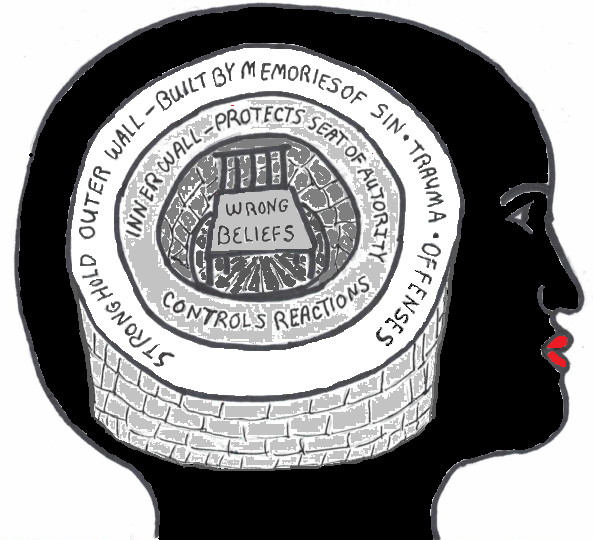
Strongholds are the mental fortresses that would look like castle walls if they had a physical form. They are built by bad memories to protect us from further emotional pain. The fact is, strongholds keep us from experiencing life and love. Mental strongholds are usually built to protect an unhealthy belief or beliefs generated by painful experiences that we have often forgotten about but still control us.  Read my blog post on unhealthy beliefs to learn more.   Authority seats are like thrones within the fortified castle (our mind).  For example, a ruler builds a fortress to protect his or her interests and authority to rule. In this case, anxiety rules our behavior and choices and is protected by the many memories of things we fear and are worried about.

THE WORRY STRONGHOLD—Protects the following unhealthy beliefs: I can’t help but to worry because I am concerned. I trust God but worry keeps me on my knees. When I worry then I can feel I am in control somehow.  This stronghold protects the fear stronghold as an outer wall around the inner fear wall.

THE FEAR STRONGHOLD— Protects the following unhealthy beliefs: Something bad is going to happen. I must protect myself. I am not able to trust anyone. This stronghold protects the authority seat of anxiety within the inner walls of fear.

SEAT OF ANXIETY—Holds all the memories of not feeling safe, which triggers panic attacks when you are in a situation where you do not feel safe.

This stronghold combination is revealed during trials and troubles, or watching the news.  Trials and troubles should  increase our faith in God, strengthen our perseverance (endurance), and perfect our character (see Romans 5:3-5; James 1:2-4; 1 Peter 1:6-9).  Most often, we allow trials to continue to build the strongholds of fear and worry, which produces anxiety, hopelessness, despair, discouragement, fretting, and depression.   For instance, anxiety is a natural response when you are in the process of losing your job because someone is retaliating against you.  When this situation happened to me, I developed a host of digestive problems, which is common.

The worry stronghold would keep me from trusting God to work all things out for my good (Romans 8:28-29).  Instead, I would dwell on the problem and try to solve the problem myself if I could. This stronghold protected the fear stronghold which encouraged self-protective behavior and the need to control circumstances. For example, if I couldn’t control the circumstances, then I would become anxious, fearing something bad was going to happen that I wouldn’t be able to control. The anxious thoughts on the seat of authority in my heart caused me to feel hopeless, despaired, discouraged, unsafe, and unhappy.  I was even anxious about the decisions my adult children were making.

I felt God leading me to mentally or physically put myself in the various homes and places where I did not feel safe or accepted. I specifically and verbally loosed/put off the destructive memories created in those places along with all oppressive energy/spirit attachments (see website for explanation), unhealthy beliefs, and wrong thinking that God brought to my mind to be transformed. After that, I prayed through the “Joy, Trust, and Peace Issues,” to complete my transformation and healing. Then I imagined myself safe in the arms of my Heavenly Father who abundantly loves me. I also made God my refuge as I often quoted Psalms 91 and Isaiah 41:10-13 from memory.   When I became free from the worry and fear mental strongholds, I was healed of my digestive problems. I could also see how this stronghold combination affected all aspects of my life.  Read the following post to learn how I got through a nasty divorce and child-custody battle, which lead to severe anxiety attacks. Trust God to Keep His Promises

To remain in peace and not be fearful, our minds should be focused on the promises found in God’s Word and not on the things going on around us that we cannot control. Personally pray the verses in Philippians 4:6-7, which states, “do not be anxious about anything, but in everything by prayer and supplication with thanksgiving let your requests be made known to God. 7) And the peace of God, which surpasses all understanding, will guard your hearts and your minds in Christ Jesus.” and Romans 8:28 which states, “And we know that for those who love God all things work together for good, for those who are called according to His purpose.”  Read, 15 Promises We Can Trust God to Keep

If you see this stronghold combination in your life, then go through the pages of my website to learn the scientific and spiritual concepts for transforming the many negative issues of not feeling safe in your heart.  1–Healing Begins by Transforming Painful Memories

The above statements are passages from my book called Unseen Battles for Your Mind, which is in the editing stage, and therefore, is not to be recopied without my permission.

Related Posts:

Why, What, and How to Submit to God (becoming free from anxiety disorder)

WHY HEAL YOUR HEART AND PURIFY YOUR SOUL?

Five Steps to Heal Your Heart and Purify Your Soul

Bondage to Unseen Controls


All verses are from the English Standard Version. If you find my posts and website helpful, please share this link with your friends and family: hopeforcompletehealing.com. The information is copyright protected. Please do not reproduce any part of the posts or my book without proper citation to Joyce Hanscom and this website. 

My latest book is Unlocking God’s Promises, which explains 18 categories of promises that are relevant to each of our lives. It also includes the promises in Psalm 91.  

If you find this website helpful, you would like to read Breaking Mental Strongholds, which expands on my website book and includes many of my posts. 

Additionally, consider my book Fighting Unseen Battles, which describes the many unhealthy beliefs that control our lives and what the truths are. To learn more about this book, read the post How to Fight Unseen Battles 

Contact me at hopeforcompletehealing@gmail.com and ask for a PDF of Eight Life-Changing Prayers from the Bible. The prayers are for the Spirit of wisdom, renewal, spiritual strength, knowledge of His will, virtues of God, non-believers, the 23rd Psalm, and victory. I will also send you the Lord’s Prayer Model to pray effectively. Please leave your name, so I know you are a real person making the request. 

Freedom from Humiliation and Mental Strongholds of Shame and Sadness

Have you been humiliated? Do you feel shame for the things that were done to you or that you have done? Do you feel sad, especially when you are alone with yourself? I think we all can answer yes to one or more of those questions. Here is my story. After I wrote in my journal about my birth and my mother’s mental state at the time (learned from letters I had found) I had a dream that night that was very perplexing. The dream was words being spoken to me that said, “shame and humiliation in a box” over and over again until I woke up. I began to pray and ask God what the meaning was. I did not receive an answer until that evening when God showed me that the shame and humiliation my mother was feeling and experiencing, translated into me and my sister while we were being formed in her womb (the box). So I looked up the words shame and humiliation in the dictionary, which gave me greater insight.

** Shame is a painful feeling of guilt, incompetence, indecency, or blameworthiness. It is a feeling of dishonor and disgrace, which may have come from the things you have done for which you need to forgive yourself for. Shame could also be put on you by other people’s unloving actions for which you need to forgive them. God showed me that shame was the inner stronghold that protected the humiliation seat, which held all the bad memories of humiliation and the wrong beliefs that I am a melancholy, depressed person and I am unable to feel joy or happiness.  God showed me that I also had a tremendous amount of guilt from the destructive things I did, which I share on my website if you are interested in knowing how I freed myself.

** Humiliation happens when our dignity is lowered, and we are caused to feel foolish or contemptible (to be scorned and made to feel worthless.) We feel humiliation when we are degraded and our honor is taken away from us. We feel humiliation when we are shown disdain, or being despised and looked down on, or disgraced; that is, a loss of favor and respect. This then opens us up to be prideful, which covers up our feelings of humiliation so in turn we humiliate others.

This is how my life began, and as I continued to journal my life, I could see these two issues throughout my whole life. We all want to be valued and accepted so I realized that this was one of the reasons I was so angry and destructive, which brought more shame and humiliation into my life.  God showed me that shame was the inner stronghold that protected my painful memories of humiliation.  In order to understand mental strongholds, see my blog on strongholds or my website.  I knew strongholds came in pairs to make sure the unhealthy beliefs and negative emotions remained to keep us in bondage, so I asked the Spirit of truth to show me what the second stronghold was. The next day I had a heavy sense of sadness, and I could see the sadness in the things that I wrote in my journal. The outer sadness stronghold had been keeping me from feeling true happiness and joy in life, in my relationships, and with God.

** Sadness is sorrow about the loss of love, honor, respect, innocence, and not being accepted. It is a feeling of dejection, which is a low spirit of depression and discouragement. Depression is brooding on one’s problems. Also, sadness is despondency, which is the loss of courage, confidence, and hope. A year later, God revealed that I was addicted to the feeling of sadness. I found this out because my mind would compulsively conjure up vain imaginations of things that would make me sad, like death or a loss of some kind. You can see how a lot of wrong and unhealthy beliefs can be developed from the memories of sadness that would also fortify the mental stronghold of sadness.

When I prayed through the specific stronghold deliverance prayer that I describe on my website, I felt greater confidence and joy, and I no longer had this cloud of sadness swirling in my mind because of the memories of humiliation.  I also broke my addiction to the feeling of sadness through specific prayer. If you can identify with what I have written in this post and would like to be free from this mental stronghold combination, then please visit my website to learn how.

The above statements are passages from my book called “Unseen Battles for Your Mind,” which is in the editing stage, and therefore, is not to be recopied without my permission.


All verses are from the English Standard Version. If you find my posts and website helpful, please share this link with your friends and family: hopeforcompletehealing.com. The information is copyright protected. Please do not reproduce any part of the posts or my book without proper citation to Joyce Hanscom and this website. 

My latest book is Unlocking God’s Promises, which explains 18 categories of promises that are relevant to each of our lives. It also includes the promises in Psalm 91.  

If you find this website helpful, you would like to read Breaking Mental Strongholds, which expands on my website book and includes many of my posts. 

Additionally, consider my book Fighting Unseen Battles, which describes the many unhealthy beliefs that control our lives and what the truths are. To learn more about this book, read the post How to Fight Unseen Battles 

Contact me at hopeforcompletehealing@gmail.com and ask for a PDF of Eight Life-Changing Prayers from the Bible. The prayers are for the Spirit of wisdom, renewal, spiritual strength, knowledge of His will, virtues of God, non-believers, the 23rd Psalm, and victory. I will also send you the Lord’s Prayer Model to pray effectively. Please leave your name, so I know you are a real person making the request. 
Escapism; Protected by Strongholds of Loneliness and Discontentment

When we don’t feel loved, we feel lonely.  Every living person has felt lonely at one time in their lives. Some of us feel lonely all the time. It is my experience and observation that loneliness comes from a love deficit, both in receiving love and giving love, but more than that, it is a lack of felt love.  The loss of felt love often happens when there is a death or divorce.  It also happens when a person is in or from a dysfunctional or abusive home that lacked felt love.  Moreover, we were created by God to be loved and to love, and when love is missing, we feel empty and alone, like an empty building, and we want to escape.

Loneliness is often accompanied by depression, which is a feeling of sadness and dejection.  Many married couples feel lonely because they do not know how to love well.  More often than not, one or both partners have not experienced a healthy love, which carries over into their marriage, and is passed down to their children. We marry looking to feel loved but when one or both have no love to give, therein lies the beginning of a dysfunctional relationship and a dysfunctional family.  The unmet desire to be unconditionally loved makes us want to isolate ourselves and to suppress our desire. We often isolate ourselves by escaping into drugs, alcohol, work, shopping, entertainment, sports, etc.

If you have not experienced healthy love, you may have a stronghold of loneliness that keeps you in bondage to unhappiness and depression. The stronghold of loneliness also protects the stronghold of discontentment.   If you are unfamiliar with double strongholds, please read the following post first: STRONGHOLDS PART I—What are they and how do they affect us?

Discontentment, according to Webster, is to lack contentment; to be dissatisfied; to have a restless desire for something more or different. To be content is to be satisfied with what one has and is not disturbed by a desire for something more or different.  Discontentment also happens when we have unrealistic expectations. The stronghold of discontentment protects the authority seat of escapism; that is, the desire to escape from our loneliness and discontentment through many different means. Some of the means of escape are: drinking alcohol, using drugs, watching TV, spending hours on social media, working long hours, playing video games, uncontrollable daydreaming, buying things, etc.

The following are the unhealthy beliefs this stronghold combination protects. The loneliness stronghold protects the following unhealthy beliefs: First, “I am alone because I am unlovable.” Second, “I need to isolate myself because I don’t trust that I won’t get hurt or I will be let down.” Third, “I am alone because I am different and unaccepted.” Some of the unhealthy beliefs, protected by the discontentment stronghold are: First, “ I need more because what I have is not enough.” Second, “I need to have something different (i.e., life, car, house, furniture, spouse, job, etc., [different for each of us]).” Discontentment has many facets, but the remedy is thankfulness and trusting God to provide the things we need (and sometimes want).

Next, evaluate what is on the escapism seat of authority (the throne) that controls your choices. I found that I needed to be busy all the time to not feel my loneliness or discontentment. I also found that I would daydream to escape the discontentment and boredom of life. Most times my thoughts were unproductive, futile, unprofitable, and empty musing. The escape mechanisms you choose may be different than mine.  Also, our escape mechanism often becomes an addiction that controls our thoughts. Please visit my website to learn how I overcame this stronghold combination and addictions with the help of God, and how you can as well. https://hopeforcompletehealing.com/


If you find my posts and website helpful, then please share the links with your friends and family, hopeforcompletehealing.com. The information is copyright protected and no part of the posts or my book may be reproduced without proper citation to Joyce Hanscom.

Contact me at hopeforcompletehealing@gmail.com, and ask for a PDF of Eight Prayers from the Bible. The prayers are for the Spirit of wisdom, renewal, spiritual strength, knowledge of His will, virtues of God, non-believers, 23rd Psalm, and victory. Please leave your name so I know you are a real person making the request.

P.S.: Experiencing a lasting change in your life depends on having a right relationship with God the Father through believing in His Son Jesus Christ and obeying His command to love (1 John 3).