

Are you naturally positive and happy from the time you were a child? If so, you have tremendous emotional resilience. Most people, however, are not emotionally resilient. You may think you don’t let hurtful people affect your thoughts, but they do. The phrase, “Sticks and stones may break my bones, but words will never hurt me,” is untrue. Words and actions are powerful.
So, what is emotional resilience? The article Why Emotional Resilience Is a Trait You Can Develop explains, “Those with a higher degree of emotional resilience can handle the stresses that come with daily life more effectively and calmly. They are also able to manage crises and mean people more easily.” In this post, you will learn how to develop emotional resilience in the face of most events involving disappointment, loss, and offense.
What Causes an Emotional Crisis?
Offenses, loss, and disappointments of varying degrees cause emotional crises. Some examples could be: Your parents didn’t get you something you wanted when you were a child. Guests arrive late, and your meal is ruined. Your pet dies. The store ran out of your favorite chocolate. You or your child fails an exam. You get a flat tire at night. You don’t get the promotion or job you want. A friend gossips about you. We face many disappointments, losses, and offenses throughout our lives, often daily. What is your natural reaction?
I can only speak for myself and what I have observed in others. Most people are disappointed by unmet expectations (stated or unstated) and become angry, frustrated, withdrawn, or depressed. When someone fails to meet your expectations, you may feel invalidated and not valued. Validation is the act of affirming a person or their ideas, feelings, actions, etc., as acceptable and worthy (Dictionary.com, 2025). Not feeling validated or valued creates a host of unhealthy beliefs about yourself that lead to shame and unloving behavior.
Some disappointments and offenses may never be resolved, and we need to accept them. For example, I never saw my father again after he left when I was 15 years old. It made me feel unvalued and insecure. I developed betrayal and abandonment issues and strongholds. Many years later, when I grieved that loss, forgave him, and asked God to heal the memory and release my resentment, then I had peace. Perhaps you were wronged by a friend or coworker or felt wronged. Often, people unintentionally offend us but do not mean to; they aren’t thinking and need grace.
Emotional Resilient Way to Handle Disappointment, Loss, and Offenses
Who would you rather be around? A grateful person or a constant complainer? Which are you? Focusing on what you can be thankful for creates positive emotions. The more you recount what you are disappointed or offended about, the more negative feelings and resentment you develop. Being thankful creates peace and joy.
What do you think when someone says you are overreacting? Do you get more emotional? To be emotionally resilient, you need to redirect your emotional response from the amygdala (the emotional brain center) to the prefrontal cortex (the logical, reasoning, and thinking brain center). I realize that the sooner I pray about the situation instead of stewing about it, the sooner I can control my emotions.
The first step is to recognize the progression of emotional reactions. Second, learn how to transfer the emotional response from the amygdala to the logical thinking prefrontal cortex. I initially designed this list to help me regulate my emotions better. Then, I further developed it to help a young boy who was very depressed and whose anger was off the charts. I shared this list in my county jail Bible study, which helped the girls understand how to control their anger and despairing thoughts.
- Acknowledge your emotions. What are you feeling? Sad, angry, frustrated, depressed, etc. Has anyone asked you to identify your feelings using a list of faces? This is good for children. Helping children identify their emotions is the first step to teaching them to be emotionally resilient. Expressing your feelings helps you move out of the amygdala and the fight, flight, and freeze modes.
- Identify the expectation that was not met. Now, you are thinking and not reacting.
- Ask yourself if your expectation was unspoken, but you assumed the other person or people knew what you expected. Now, you are being logical.
- If you stated your expectation, did the other person/people acknowledge or understand it, and did they agree to fulfill it? Now, you are reasoning.
Let’s say you expected the dishes to be washed and put away, and the kitchen to be clean when you got home, and you had made your expectations known. You come home after several hours, the dishes are not done, and the kitchen is not cleaned. What do you do? The following “Victory Plan” takes practice, which we get plenty of in this fallen world. Remember, everything you do is to be done in love (1 Cor. 16:14).
I want to add one more healthy practice to the Victory Plan: When you feel emotional about a situation, do not address the issue with the person at that moment. Do not send a text or email while you are emotional because you can’t take back your words. Romans 12:17-18 states, “Repay no one evil for evil, but give thought to do what is honorable in the sight of all. 18If possible, so far as it depends on you, live peaceably with all.” The Apostle Paul gave this mandate to us, which seems impossible, but all things are possible with God (Matt 19:26). Continually praying will help you become emotionally healthy because as soon as you are disappointed or offended, you will give it to God before it turns into resentment.
VICTORY PLAN OVER ANGER, DEPRESSION, and ANXIETY
1. Acknowledge your disappointment. Ask, “What can I be thankful for?” Disappointment from unmet expectations can leave you feeling angry or sad, but you don’t want to ruin a relationship with your anger or silence. Recall the following truth: “I can rejoice always, pray without ceasing, and be thankful in everything for this is the will of God…” (1Thes.5:16-18). When I’m upset, I stop and ask myself what has disappointed me. I pray and surrender my hurt feelings to God, asking what I can be thankful for instead. You should talk to the person who disappointed you, so ask God to help you understand how you will manage the interaction with love. Next, I pray, “Lord, help me accept that things won’t always go as I expect. Take my disappointment. Please help me understand how to manage unmet expectations. I will be thankful for __.”
2. Capture unhealthy thoughts that lead to strong emotions. Ask, what am I thinking right now? Say to yourself, “I want to be controlled by love.” Remind yourself that love is patient and kind; love does not envy or boast; it is not arrogant or rude. It does not insist on its own way; it is not irritable or resentful (1Cor. 13:4-5). Tell yourself that God will help me, I don’t have to be afraid (Heb. 13:6). Ask God how to manage the disappointment as He would. Then pray something like the following. “Lord, take my unhealthy thoughts of ___ and give me the right thoughts according to Your truth and will. Help me submit to Your standard of love and love others and value them as I love and value myself.
3. Admit your hurt feelings, such as not feeling validated or feeling unloved and rejected, and so on. Recognize you are offended and resentful. Forgive those who hurt you or who offended you. Pray for those who mistreat you (Matt 6:12 and 5:44). Be kind and tenderhearted. Forgive as Jesus has forgiven you (Eph. 4:32 & Col. 3:13). Acknowledge that you feel hurt, mad, or afraid because ___. Ask: Do I feel rejected? Unworthy? Unloved? Betrayed? Next, pray something like the following: Lord, I forgive _(person)_ for _(what they did or did not do)_. Take my hurt feelings and resentment from me. Thank You for filling me with Your love and acceptance, in Jesus’ name.
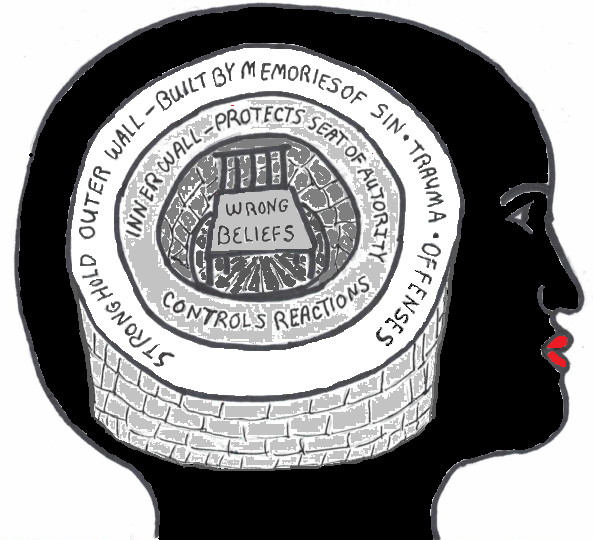
4. Identify wrong beliefs about yourself, others, or God from that disappointing situation. What do I believe about myself at this moment? What do I believe about the person or situation at this moment? Wrong beliefs control your emotions and actions, so identifying and replacing them with correct beliefs will help you transition from feeling emotions to thinking rationally. An incorrect or unhealthy belief is a lie about the true nature of reality, and we need to shine truth into our hearts to correct these lies. For example, if you believe you are not worthy of love, you believe in a lie. It is a faulty conclusion. Replace the unhealthy beliefs with these truths: I have worth, I am accepted and loved, I am complete in Christ, and I am a new creation (Col. 2:9-10; 2Cor. 5:17). I am valuable because I am made in the image of God; this makes me significant (Gen. 1:27). The person who offended me is valuable and worthy of being loved. Next, pray, Lord, remove the influence of evil spirits from my mind, which leads me to hold wrong beliefs. Remove these wrong beliefs from my mind and help me believe your truth about myself and others in Jesus’ name.
5. Confess sinful actions and hurtful behavior. The longer you think unhealthy thoughts, feel angry or sad, and believe lies about yourself and others, the greater the chance you will sin. Ask, “What did I do that hurt another person because of my unloving, out-of-control feelings?” What did I do that disobeyed God’s law of love, as defined in 1Corinthians 13:4-6?” King David said, “I confess my iniquity; I am sorry for my sins” (Psalm 38:18). The Apostle John said, “If we confess our sins, he is faithful and just to forgive us our sins and to cleanse us from all unrighteousness” (1John 1:9). Next, pray, Lord, forgive me for ___. Help me be self-controlled and love others by being at peace, kind, and patient with them, in the name of Jesus.
If you want a PDF of this Victory Plan, email me at hopeforcompletehealing@gmail.com, which helps you have a healthy mindset for healthy conflicts.
- It is beneficial to journal about the things in your past, from your earliest memories of disappointment, resulting in resentments and false beliefs.
- Go through this victory plan for each disappointing memory.
- Be mindful to breathe deeply as you follow the victory plan and repeat the truth often.
- Write down what happened, who was involved, who needs forgiveness, and how you reacted unlovingly. What unhealthy beliefs were created to reinforce wrong thinking?
- To learn more about how to be free from past painful memories, read my online book at hopeforcompletehealing.com.
Check out each of my worksheets to uncover hurt feelings from disappointments and become free from their control over your thoughts and actions.
MEEKNESS, HUMILITY, AND GENTLENESS Issues
What is An Emotionally Healthy Person?
May God bless you richly as you seek His help to be completely healthy.
**************
All verses are from the English Standard Version. If you find my posts and website helpful, please share this link with your friends and family: hopeforcompletehealing.com. The information is copyright protected. Please do not reproduce any part of the posts or my book without proper citation to Joyce Hanscom and this website.
My latest book, Unlocking God’s Promises, explains 18 categories of relevant promises to each of our lives. It also includes the promises in Psalm 91.
If you find this website helpful, you would like to read Breaking Mental Strongholds, which expands on my website book and includes many of my posts.
Additionally, consider my book Fighting Unseen Battles, which describes the many unhealthy beliefs that control our lives and what the truths are. To learn more about this book, read the post How to Fight Unseen Battles.
Contact me at hopeforcompletehealing@gmail.com, and ask for a PDF of Eight Life-changing Prayers from the Bible. The prayers are for the Spirit of wisdom, renewal, spiritual strength, knowledge of His will, virtues of God, non-believers, 23rd Psalm, and victory. I will also send you the Lord’s Prayer Model to pray effectively. Please leave your name, so I know you are a real person making the request.


 Hope for Complete Healing